Sexism in Bachata
First of all, I would like to say that everyone has different personal borders. What may seem OK to me, may not feel OK for you, or the...

Lou
Mar 9, 20221 min read

Bachata Stuttgart by Lou

dancing can be so much more than just moving


A personal Reflection on my Journey and the evolving Bachata Community in Germany
Over the years, my relationship with Bachata and with the community around it has changed profoundly. In 2021/2022, I went against many expectations by choosing Role Rotation, focusing on Traditional Bachata, and teaching partner classes on my own as a female instructor.
These decisions were not spontaneous. They were the result of long observation, discomfort, social analysis, psychological education, and critical self-reflection.
What led me to these choices?
Why did I decide not to look for a new (male) dance partner to teach with?
Why did I implement Role Rotation as the fundamental methodology in my classes?
Why did I shift my focus toward Traditional / Dominican Bachata and left the Sensual Bachata scene?
Below you can also read the my reflection on this journey and the appreciation I feel for all the people involved in this process of professional and personal growth and success.

1. Choosing Independence: Teaching Partner Dance as a Solo Female Instructor
The truth is: I found it very unfair that I was expected to solely teach “lady style” classes or to become someone’s assistant - simply because my former dance partner and I had ended our joint projects. I felt social pressure. The community expected me to choose a new male dance partner in order to continue my career as a couple dance instructor. It does make sense to couple up, because couple dance is a dance for two. But I didn’t want to limit myself to teaching only styling or being dependent on a man. After enduring many moments of discrimination by male organizers, dance school owners, teachers, and dancers, I felt ready to face a new challenge.
However, my problem was that although I had always taught Bachata, I had never really practiced leading myself. It had never crossed my mind, because until that point I had always focused on becoming a very good follower first. I had to be honest with myself: I was also part of a society and a community in which I had simply accepted the traditional role I was given. I was part of the problem - even if I had not benefitted from that system the way male dancers and instructors have. That realization felt uncomfortable and made me angry. I blamed myself for a situation that was now closing doors in a career I had invested in for many years.
After Jorge & Lou ended, I realized that this was a decision - a choice I could make right then and there. I was terrified, and honestly, building the confidence to follow my own instincts and to push through was something I achieved by hard work, talent, profound motivation and emotional strength, but also by the support of Felipe &Tiago and my partner at the time - 3 amazing men.
It's not about the biological sex. It's about the mindset and authenticity. Dance is not separate from society. What happens on the dance floor reflects broader dynamics. As a female instructor, follower, and event organizer, I encountered challenges that many of my male colleagues never had to face.
Those experiences were driven by patriarchal concepts - often promoting and normalizing sexism, misogyny and exploitation which harms women - and men - on so many different levels. So yes, dancing can indeed be political. In fact, many things we do become political - whether we want that or not.
Over time I realized more and more, that the social construct of gender is what limits us - not the biological sex. Concluding that the definitions of masculinity and femininity are designed by humans also meant that they were dynamic and adjustable. I had never quite felt comfortable with the definitions of what a man or a woman supposedly was (or has to be like). Neither had I ever completely accepted them - it just didn't feel natural to me. So instead of questioning if I was dancing out of line with my critics, I started questioning the system that was not flexible, nor safe or inviting for women if they didn't want to be restricted, and forced into a stereotypical male-centered ideal of a "feminine" dancer in latin couple dance.
After I had already been talking repeatedly about sexism in Bachata Sensual style on social media, I realized that I could do more. My next step was addressing the systemic discrimination by refusing to partner up with a new male dance partner. I knew that meant being willing to feel uncomfortable, being excluded and criticized. But when it happened it was still a challenge: long discussions, verbal attacks, exclusion from events, insults, difficult payment negotiations, ... and many sleepless nights.
This decision became an important act of rebellion for me. It marks a professional and personal milestone in my journey. To this day, I continue to be proud that I did not give up but listened to my heart instead. This liberated me slowly. It helped me to allow more authenticity to guide me in my decisions and approaches.
2. From Control to Connection:
Why I Teach Role Rotation
My biggest motivation for teaching Bachata using Role Rotation was to offer a different way of accessing the experience of partner dance. I grew tired of repeatedly witnessing violated boundaries in social dancing - boundaries I had assumed to be common sense. Those boundary violations affect women more than men due to the fact that most women take on the follower role and most men the leading role. This keeps women in a passive and vulnerable position - especially in Sensual Bachata style. I kept asking myself what I could contribute to create a safer environment at Bachata socials.
At the same time, I noticed how Bachata Sensual style increasingly turned into a show dance, performed primarily to entertain an audience - or the partner one is dancing with. This began to bother me, as I felt the style became more shallow and more sexist over time. Traditionally gendered dance roles - in which women are expected to look pretty and sexy while merely executing impulses given by a male leader - started to feel exploitative. Often, these leaders are not able to dance the complicated movements that they demanded from the follower themselves.
In Germany, female latin dancers outperform male latin dancers with a larger proportion using better technique, improving faster, having better body-coordination, better musicality, implementing more aesthetics (styling) in their dancing and showing more flexibility when it comes to the range of dance styles they have mastered. The patriarchal structures backfired: having labeled dancing as a female activity in German culture (and many others) has resulted in the lack of male dancers and a big discrepancy in the learning curve between the genders. Men dancing Bachata in Germany have mainly extracted confidence from being the one in charge - the leader. That does not necessarily relate to being good dancer.
The lack of distinction between being a good dancer and being able to lead many combinations shows on the dance floor and can turn into unpleasant experiences for the (female) followers:
1. Body movements and aesthetics are lacking in a large proportion of men who focus solely on their leading.
2. The technique of good and smooth leading is often disregarded and replaced by force instead.
3. The widely spread strict role separation expects leaders to dictate how the dance evolves while the followers do not have much influence. This does not only put a lot of pressure on the male leaders but also demands high skills of the followers - being responsible for the aesthetics and the refinement of the dance - adjusting and fixing what male leaders are often not providing. Much of those constant reparations maintain invisible to the outside - and even to the insensitive leader. However, female followers are expected to do them - and we do "willingly" and constantly without even noticing how much of that makes the dance even feasible or aesthetic. But this has nothing to do with that being fun and bringing joy to the follower, as she has to surrender her independence as a reaction to the skill level of the male leader. Not as an active choice for her own pleasure.
4. The musicality might be completely off. The lack of exposure to "Dominican" Bachata music - not remixes - prevented the development of a deeper musical understanding. In a culture in which dance and music has stopped being a valuable commune aspect, good musicality is a skill rarely to be found.
5. In addition the vibe in Bachata Sensual style became increasingly more of a "I show you what I got!" rather than a "I am here to adapt to you and find out together how the next 3 minutes evolve".
Years of experience, exposure and active work in and with the latin dance community in Germany - and beyond - have confirmed over and over again that the gender identity built around couple
dance negatively impacts the quality and community. It was clear, that the problem is not an individual one, but a systemic one.
Further, in terms of payment, bookings, respect and influence among the dance community, male latin dancers, instructors and organizers have been benefitting enormously, regardless of their skills or ethics.
Having experienced all the mentioned aspects on the dance floor myself for many years obviously left me wondering why everyone just accepted these conditions. Isn't a safe environment and a respectful vibe what would help us all to feel more comfortable after all? How did we as a community become so blind to what couple dance actually means?
My personal experience
It was not uncommon for me to try to express myself through the music, only to often be denied that space and instead forced into movements chosen by the leader. I had always actively asked leaders to dance with me, even before I could lead, but I knew and saw that most women wouldn't do that back then. I refused to do certain sexual movements only to be corrected on the dance floor by the male leader. The male leaders could not imagine that it was not a lack of knowledge but a lack of consent which made me block their leading. I was dropped on the floor and hurt my knee, because of poor leading technique, I was touched in between my breast and I was kissed on my arm. I was touched "romantically" in my face various times during dance, my hair was caressed sexually during a dance, my outfits were commented and rated by men, I was ignored only because I didn't wear heels, I was spun and torn around like an object, regardless of my physical abilities, the space available on the dance floor, my energy or skill level - and above all regardless of my leader's skills. I was dragged onto the dance floor by strangers without my permission, grabbed violently by the arm in the middle of conversations. I was taken away the drink in my hand to then be dragged onto the dance floor from male strangers. I was disturbed while dancing with a woman, because a man was convinced he was the missing piece in an equation nobody had made but him. I was held captive in shadow position and close position by men who rubbed their body against mine without my consent. I was "accidentally" touched in private areas of my body while dancing, I was yelled at and threatened when I called out an abuser who repeatedly touched female beginners while dancing and I was dismissed, and even insulted for speaking up against all that online.
I wish I could say that this was just me having had bad luck. But more and more observations and stories of other women revealed the systemic dimension. It's most women. But to most men this part remains invisible. Or just an unpleasant side effect of some "black sheep" in the community. Men don't fathom the dimension of the burden they place upon women or themselves by behaving - or dancing - in such a way.
Finally, I had accumulated enough anger to speak up publicly. I wanted to help recreate a safe space for everyone. I believed that by focusing more on the empathy - which is required to form real connection in partner dance - we could return to more meaningful dances - grounded in respect and mutuality rather than gender stereotypes, hyper-sexualization and rigidity.
As a result, Role Rotation became the methodology that best served this purpose.
My students are free to choose whichever role they prefer at socials. In my classes, however, I make no exceptions: everyone learns how to lead and how to follow and everybody dances in same sex constellation as well.
My personal belief is that gently questioning traditional gender role identities by practicing leader and follower qualities equally can foster greater empathy and respect, both on and off the dance floor. Gender equality and empowerment are the principles guiding my psychology-based embodiment concept in my dance classes. They enable a lived and felt experience rather than a theoretical idea. This benefits all genders and liberates everyone from the pressure to perform a certain social role.
This approach has become the norm in my classes, and I am proud of the small community in Stuttgart that has grown with me throughout this process.


3. Returning to the Roots: Why Tradition Matters
Aside from the critique already mentioned, I began to miss the cultural characteristics of Bachata from the Dominican Republic - the very reason I had originally started dancing Bachata back in 2015. I found myself wondering what had happened to both me and the community in the meantime. Since I had started dancing Bachata hardly anyone had wanted to dance the "Traditional" Bachata style. Back then, there were almost no classes teaching this style in Germany, even though more and more people were learning and teaching "Bachata". "Bachata" was a term used to refer to Modern Bachata or Sensual Bachata style in Germany. Most dancers didn't know what Bachata really was. On the one hand, the growing popularity of "Bachata" was a positive development - it gave dancers an alternative to Salsa. On the other hand, I felt increasingly responsible for passing on cultural context to my students - knowledge about history, roots, and traditions. I had always done this to a certain extent, especially verbally, but I had mainly practiced Modern and Sensual Bachata style myself. I was not an expert in "Traditional" Bachata. So I asked myself: what now?
I began taking many classes and workshops to broaden my own perspective and to reconnect with my “Dominican love” from 2015 - Bachata. I hoped that deeper cultural knowledge would ultimately lead to a better understanding of both the dance and the music. This is why I started to focus more on "Traditional" Bachata - or, as Dominicans simply call it, Bachata. I use the term “Traditional” or “Dominican” simply to avoid confusion, since in Germany the word "Bachata" is still primarily associated with Modern or Sensual styles.
The unique hip movements and footwork of Traditional Bachata make a significant difference on the social dance floor, giving the dance a more organic, grounded quality. I missed smoother expression, deeper groundedness, and stronger musicality in the way I increasingly saw Sensual Bachata being danced socially. I knew that returning to Traditional Bachata was the only way to truly strengthen these skills. But more than technical skills I was seeking a feeling. A deep feeling of fun and lightness. A feeling of playfulness and autonomy. A feeling of mutual understanding and respect.
I could feel that that was what originally fascinated me about Bachata, so it felt almost as if I was coming back to myself.
In addition, I became increasingly aware that as a German teaching a dance rooted in another culture could rightfully raise questions of cultural appropriation. I felt a responsibility to pass on as much knowledge as possible about Bachata’s origins - especially as a counterbalance to the direction Bachata Sensual style was headed. Interestingly, Bachata danced the Dominican way is more inclusive, more relaxed, more community focused, and promotes a dynamic and active participation of both partners.
I found greater joy in Bachata again, because it combined a specific Caribbean vibe, precisely the Dominican culture, with dance and community.
It felt like a simple but essential form of respect toward the Dominican culture to study more about it and to implement that knowledge as much as possible.

From Reflection to Responsibility
I reached a point where I no longer wanted to continue complaining about a dance community I had been part of for many years. Yes, it has been harder as a woman to work independently and to be booked. Yes, sexism is real and continues to be a problem. But I also ackowledge a significant improvement over the past years - and that makes me genuinely happy.
Yes, I love being a follower, and I would never want to miss that experience. At the same time, I am proud to be a female leader who encourages other women to be brave enough to try leading as well, and who encourages men to practice letting go of control and to question homophobic stereotypes. This feels deeply important, not only for dance, but for our society as a whole. So, I would never want to miss out on the experience as a leader: I built more resilience and confidence. It confronted me with my own fears, insecurities and limiting convictions. Ever since, I actively embrace the opportunity to redefine womanhood and strong leadership for social communities, across cultures and across age.
In other words, I simply wanted to take matters into my own hands and actually do something about it.
We shape the world we live in. And it is never too late to pause, pivot, and choose a different direction. Trends are not always a good thing for everyone.
My academic career as a psychologist has given me the tools and knowledge to access and assess scientific research which examines restrictive and harmful gender roles. Everything I have written here is based on scientific and experienced knowledge. It has inspired me to write my master's thesis on masculinity in the context of leading and following experiences.
On the other hand, my curiosity and temper makes me gravitate naturally towards cultural exchange, which is why I started to study more and more about the Afro-Caribbean history. Since I am aware that teaching a Latin-Caribbean dance as a white, European woman comes with a specific responsibility, I use my knowledge to educate my students on the cultural diversity we experience through dance and music, enhancing my students' curiosity on the Caribbean cultures and gently questioning our cultural norms by presenting alternatives. This means that joining one of my dance classes is never just a physical activity, but rather partaking in a holistic, cultural, as well as personal experience.
Combining psychology, sociology, philosophy, history, anthropology with art in order to fathom different aspects of humanity will most likely be a never ending process - and I am glad to say that. Call me melodramatic, but I am positive that the day I stop learning will most likely be the day I stop breathing. There is so much I don't know yet and there is so much that can be discovered.
Perhaps this comes from being a psychologist, a poet, and someone drawn to philosophy - but I want to end with this thought: It’s about authenticity. No one but yourself can tell you what is right for you. It takes courage to find out who you are and what you want. What you want can change over time. Because we change as human beings throughout our lives. So it's always good to check in with ourselves and adjust if something doesn't feel right. It means sitting with fear, anger, guilt, and shame - and allowing growth to happen anyway.
Today, I trust myself more than ever before. I choose who and what I spend my time with. This expands beyond my dance activities. I set my boundaries, whether that fits into a stereotypical idea of a woman or not. Years of reflection on Bachata and partner dance, as well as societal expectations and rigid gender roles, has made me more calm. But it required to go through the pain, anger and grief. It required making peace with the parts of myself which were driven by external validation and internal doubt. Now, it enables me to meet dancers in a different realm, where pressure exists only if the authentic self is suppressed too much. I can't make the decision for the person I am dancing with - it's up to them if they can allow or endure an authentic version of themselves - but I can make that conscious approach for me: Do I want this particular dance with this particular person? And if yes, how do I want it? Do I feel authentic? Am I having fun? Do I feel seen and respected as the person I am right here and right now? That's what I can take care of. If I take that responsibility for myself I am able to meet the other person along the way. If they will be there? I don't know, but I don't have to walk all the way over to them. It's still a partner dance. It requires two. That's what my students can explore as well, if they want to: a sense of agency, self-efficacy, trust, joy and curiosity. And after all, in best case, we let the bodies do the talking.
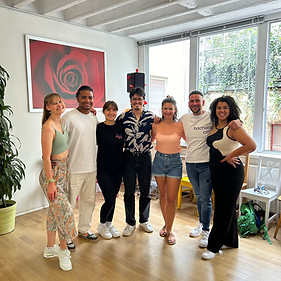


J.R., who believed in me when I didn’t and who helped me rebuild my dance school from scratch in winter 2021/2022.
F. & T., who inspired and mentored me through the transition to Role Rotation.
Y.M., who eventually gave me the chance to teach Bachata in his dance school in Tübingen.
B. & S., who mentored me in my return to the roots of Bachata.
C.S., who gave me a place to start my own dance school in 2022 in her dance studio in Stuttgart.
F.S., who supports me with her creativity and designs.
M.I., who was my male assistant, as I started teaching Role Rotation in Stuttgart.
F.H., who trusted me to host my Bachata party series and my courses in their beautiful space in Stuttgart.
K.D., who introduced me to Dominican culture in spring 2015 and taught me my first Bachata and Merengue steps.
J.O., who joined my dance journey at the end of 2015 and helped build a community in Aachen and Tübingen.
A.T., who welcomed me with open arms in Barbados in 2024 and invited me into his dance school.
F. & J., who were the first organizers in Stuttgart who hired us back in 2017.



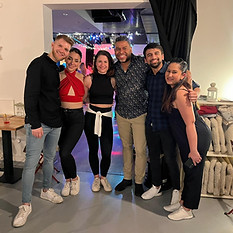

...all the female and male organizers and teachers who didn’t hesitate to hire, support me, and collaborate with me as a solo instructor and organizer across borders.
...my friends, who held space for my tears and fears, but also my achievements.
...my students, without whom none of this would be possible - their trust is what makes Bachata Stuttgart what it is.
.. and I thank myself for listening to my gut feelings and for continuing to learn and evolve.


One person doesn't make a difference. It's always a network of support and an exchange of professional knowledge that inspire and enable growth on a larger scale.